



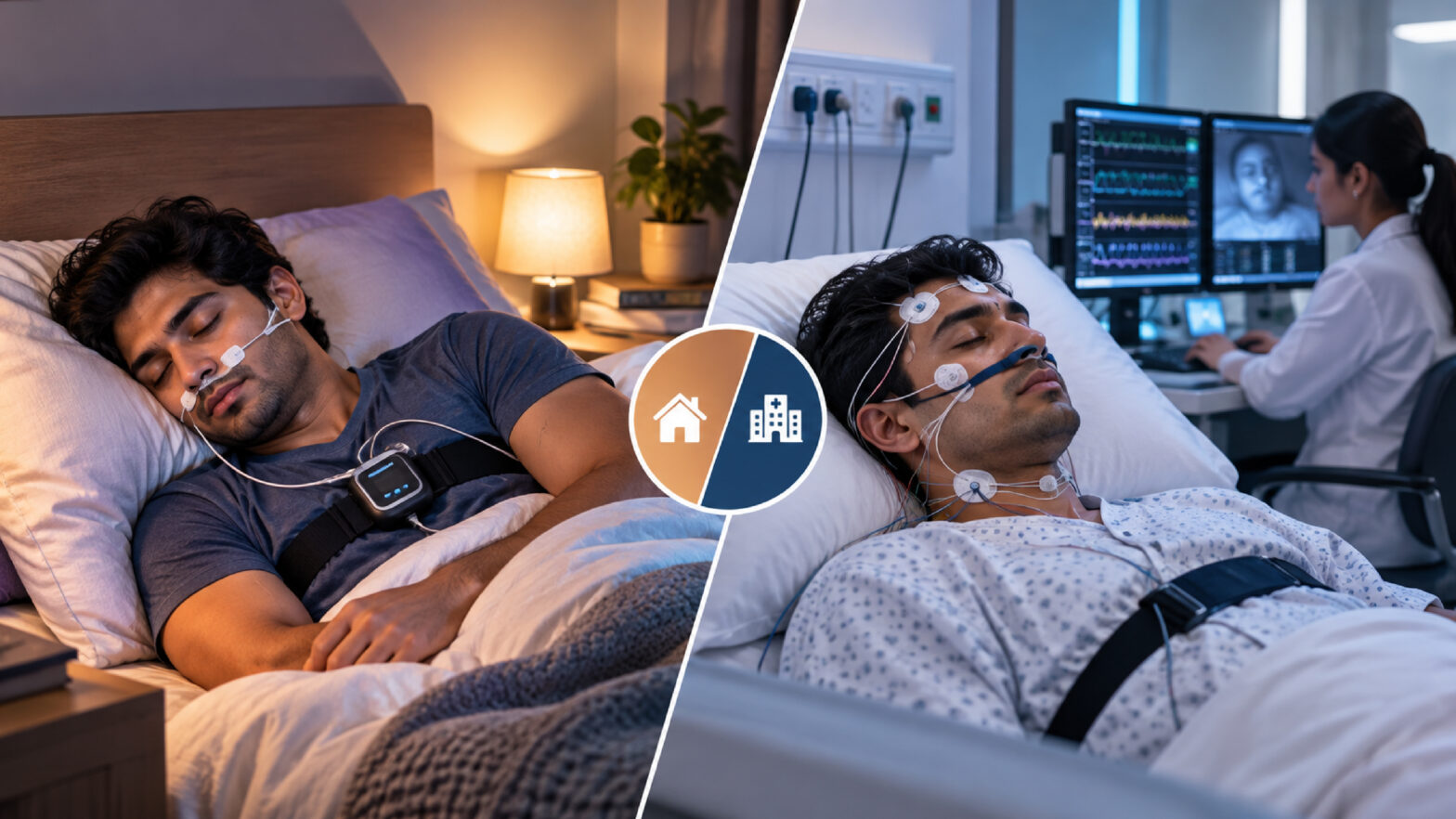
When sleep has been poor for a while, getting tested can feel like another thing to figure out. Then comes the next question: should the sleep study happen at home, or should it be done in a sleep lab?
Both options can tell doctors useful things, but they are not quite the same. The better choice depends on what symptoms are present, what needs to be checked and how detailed the testing needs to be. For someone dealing with loud snoring, daytime sleepiness or suspected sleep apnea, knowing this difference can make the decision a little less confusing.
A sleep study is not simply about checking whether someone sleeps for eight hours. It looks at what happens while sleep is taking place.
Depending on the type of test, it can monitor breathing, oxygen levels, heart rate, body movements and other signs. These details can help a sleep doctor understand whether the problem is related to breathing, disrupted sleep or another sleep disorder.
That matters because feeling tired every morning does not always have one obvious reason.
A home test can seem much easier, and in some cases, that is exactly the point. The person sleeps in their usual surroundings, rather than spending a night somewhere unfamiliar.
Home testing is often considered when the main concern is sleep apnea, particularly in people who have symptoms such as loud snoring, breathing pauses or excessive daytime sleepiness. The equipment is usually designed to collect specific information without making the whole night feel like a medical procedure.
Still, a home test is not suitable for every sleep problem. It may not provide the detailed picture needed when symptoms are more complicated.
A sleep lab offers a much closer look at what happens throughout the night. More signals can be monitored, and trained staff can keep an eye on the testing process.
This can be useful when a person may have something more than straightforward sleep apnea. Unusual movements during sleep, certain neurological sleep problems, persistent unexplained sleepiness or a home test that does not give a clear answer may call for more detailed testing.
The surroundings are different from home, of course. That can make some people slightly uncomfortable. But the extra information can be worth it when the diagnosis is not obvious.
Not necessarily. The important part is using the right test for the right situation.
A home sleep study can be useful when the suspected problem fits what the test is designed to measure. But if the symptoms do not match that picture, a lab-based study may be a better starting point.
This is where talking to a sleep doctor matters. Instead of choosing a test simply because it is cheaper or more convenient, the symptoms can be looked at first and the testing can follow from there.
Naturally, sleep study cost comes into the decision. Home testing may cost less in some situations because it does not require an overnight stay in a sleep facility. Lab testing can involve more monitoring and staff support, so the cost may be higher.
But price alone can be a poor way to choose. If a home test does not answer the question and another test is needed afterwards, the cheaper option may not actually save much. It is better to ask what the recommended test is expected to find.
The actual sleep study cost can also vary depending on the type of test, the facility and what is included.
A person who snores loudly and wakes up tired may have a very different situation from someone who has chronic insomnia, strange movements at night or repeated unexplained awakenings.
That is why a sleep study should not be treated as a one-size-fits-all test. The symptoms give the first clues. A sleep doctor can then decide whether home testing is enough or whether a lab can provide a clearer picture.
Even details that seem small, such as a partner noticing gasping during sleep or repeated leg movements, can be useful during the consultation.
We know that choosing between a home test and lab-based testing can feel confusing. We help patients understand why a particular test may be recommended rather than expecting them to work it out alone.
At Sleep Therapeutics, sleep diagnostics are part of a wider process rather than something patients have to figure out on their own. Our state-of-the-art sleep labs allow detailed overnight evaluation when it is required, while the initial consultation helps determine what kind of assessment makes sense. The idea is to choose testing based on the sleep concern, not simply because one option sounds more advanced.
There is no universal winner between a home and lab-based sleep study. For some people, home testing is a practical and suitable option. For others, the symptoms call for closer monitoring in a sleep lab.
A good sleep treatment center in Hyderabad should look at the person and the symptoms before deciding on the testing route. That way, the test is not just something to complete. It has a clear purpose.
At Sleep Therapeutics, we focus on understanding the reason behind the sleep problem and then choosing the appropriate diagnostic path. A sleep study is simply one part of that process.
It can be useful for people being evaluated for certain sleep disorders, especially suspected sleep apnea, when recommended by a doctor.
Not necessarily. A lab-based test gives more detailed information, but the right choice depends on the symptoms and what needs to be checked.
A sleep treatment center in Hyderabad with sleep diagnostics and lab facilities can help determine which type of testing is appropriate.